
Off-the-shelf signs cover the majority of workplace hazards, but every site has situations where a standard sign simply won't do. Custom safety signs let you communicate site-specific hazards, rules and procedures with the same AS1319 format customers already recognise — just tailored to your workplace.
Custom signs vs off-the-shelf — when do you actually need custom?
Most workplaces don't need custom signs. The Australian Standards (AS1319, AS1345, AS2293) define the wording, colour and pictograms for every common workplace hazard, and our standard catalogue covers those at lower cost and faster turnaround than custom production.
Custom safety signs make sense when off-the-shelf can't cover the situation:
- Site-specific hazards: "Danger Acid Transfer Line — No Access During Transfer Operations" — not something you'll find in a catalogue.
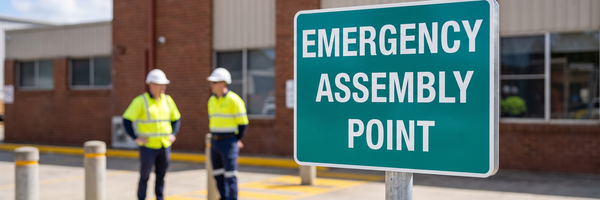
- Company procedures: Site induction signs, visitor check-in processes, evacuation assembly points with your site map.
- Multi-message signs: Combining PPE requirements, speed limits and authorised personnel restrictions on a single sign at site entry.
- Branded signage: Site rules, induction signs and reception signs carrying your logo and corporate colours.
- Equipment labelling: Plant identification, asset tags, lock-out tag-out signs with serial numbers and specific warnings.
- Unusual sizes or shapes: Bollard wraps, large site boards, curved surfaces or very small equipment labels.
- Multilingual workplaces: Signage in multiple languages for sites with non-English-speaking workers, visitors or contractors.
If your need fits one of those, custom is the right choice and the rest of this guide walks you through ordering. If it doesn't — our standard Australian Standard signs catalogue will be cheaper and quicker.
How the Custom Sign Process Works
1. Brief
Tell us what the sign needs to say, the hazard it addresses, where it's going (indoor/outdoor, wall/post/equipment), and any branding requirements. A simple email with a rough sketch is often enough.
2. Quote
We send back a quote covering artwork, material, size, quantity and lead time. Most standard-format custom signs are surprisingly affordable.
3. Artwork Proof
Once an order is placed and paid for, our design team produces an AS1319-style proof for your approval. Custom signs retain the correct colour standards, pictogram formats and layout principles — your message, the recognised format.
4. Production
Once approved, signs are manufactured in our Melbourne facility. Typical production time is 3-5 business days for standard materials; longer for specialty substrates or very large quantities.
5. Dispatch
Nationwide delivery via Australia Post or Common Carrier.
Material Options for Custom Signs
Material choice affects durability, appearance and price. The right pick depends on where the sign is going:
- Metal: Weatherproof and UV-stable. Best for outdoor, car parks, fence-mounted and front-of-house signs.
- Aluminium: Rigid, lightweight and corrosion-resistant. A durable option for long-lasting indoor and outdoor signs.
- Polypropylene: Lightweight, flexible, economical. Ideal for indoor, temporary signs and site induction boards.
- Self-adhesive vinyl: For flat surfaces — equipment, machinery, bins, doors. Available in standard, reflective and photoluminescent.
- Corflute: Low-cost temporary signage for construction sites, events and short-term installations.
- Reflective vinyl: Class 1 or Class 2 for high-visibility day and night applications — essential for outdoor traffic and hazard signs.
- Photoluminescent: Glow-in-the-dark material for escape routes and emergency signage requiring visibility during power failure.
Artwork and Content Tips
- Keep the message short. Fewer words, bigger type, read at a glance. "Danger — No Access" beats a paragraph of safety policy.
- Use AS1319 colours. Red for prohibition and danger, yellow for warning, blue for mandatory, green for emergency. Don't mix categories on one sign.
- Provide logos in vector format. SVG, EPS or AI files reproduce cleanly at any size. JPG logos from websites tend to pixelate.
- Standardise across sites. Multi-site businesses benefit from a single set of custom templates used consistently everywhere.
- Order a few extra. Signs fade, get damaged or go missing. Ordering 10% extra in the original run avoids a second setup fee later.
Ready to Order Custom Safety Signs?
Get a free quote. Our design team will turn your brief into AS1319-compliant artwork within 24 hours.
Suggested Reading
Disclaimer: The information provided in this article is intended as general guidance only. Safety signage requirements may vary between states and territories across Australia. Always consult your local regulatory authority and seek professional advice to ensure compliance with the specific requirements applicable to your workplace and jurisdiction.