
No Entry & Authorised Personnel Only Signs Explained
Restricting access is one of the cheapest risk controls a workplace has, and one of the most commonly signed badly. Many sites have a No Entry sign on a door that only needs a Notice, or an Authorised Personnel Only sticker on a switch room that legally warrants a danger sign. The wording is not interchangeable, because under AS 1319 the sign’s shape and colour tell a worker how serious the restriction is before they have read a word of it. This guide covers what each sign means, which one belongs on which door, and where to put them. It sits alongside our broader guide to prohibition signs and AS 1319 compliance, and you can browse the no entry signs range to see the formats.
What are no entry and authorised personnel only signs?
No entry and authorised personnel only signs are access-control safety signs: they tell people that an area is closed to them unless they have been given permission to be there. They are used on plant rooms, switch rooms, chemical stores, confined spaces, workshop floors, roof access hatches, loading areas and any part of a site where an untrained person could be hurt or could interfere with something they should not.
The two phrases do different jobs. NO ENTRY is an instruction: do not go in. AUTHORISED PERSONNEL ONLY is a qualification: entry is limited to a defined group. Most sites need both: the first on areas nobody enters without a permit or an escort, the second on areas where the regular crew works but visitors and contractors do not.
What AS 1319 requires of a no entry sign
AS 1319-1994 Safety signs for the occupational environment is the Australian Standard that sets the design of workplace safety signs. It groups them by function and gives each group a fixed colour and shape, so a worker reads the class of message from across the room and the detail up close.
A no entry sign is a prohibition sign. The format is a red circular band with a red diagonal bar struck through a black pictogram, on a white background, with any supplementary wording in black beneath or beside it. Prohibition means one thing under AS 1319: this behaviour is not permitted. That is why the red circle should be reserved for restrictions you intend to hold people to, rather than sprayed across every internal door.
Two practical points follow from the standard. Size the sign to the distance it has to be read from, because AS 1319 ties minimum sign dimensions to viewing distance, and an undersized sign at the end of a long aisle is decoration. And do not confuse the workplace No Entry prohibition sign with the road-rules No Entry device (the red disc with a single white horizontal bar), which is a traffic control sign under the road rules and belongs on roadways, not on a plant room door.
Prohibition, danger or notice: which sign for which area
This is where most restricted-access signage goes wrong. Three different formats say “stay out”, and they are not equivalent:
- Prohibition (red circle and bar): “No Entry. Authorised Persons Only”. The default for an area that is genuinely closed: confined spaces, chemical stores, roof access, plant rooms.
- Danger (DANGER in a red oval on a black header): reserved by AS 1319 for hazards that could be life-threatening. Use it where the reason for the restriction is the hazard itself, such as a high-voltage switch room. Our guide to danger signs and their AS 1319 format covers the distinction, and electrical safety signs covers switchboards specifically.
- Notice (blue header, white panel): “Authorised Personnel Only” as a site rule rather than a hazard warning. Right for offices, staff-only areas, back-of-house and store rooms where nothing is going to hurt anybody.
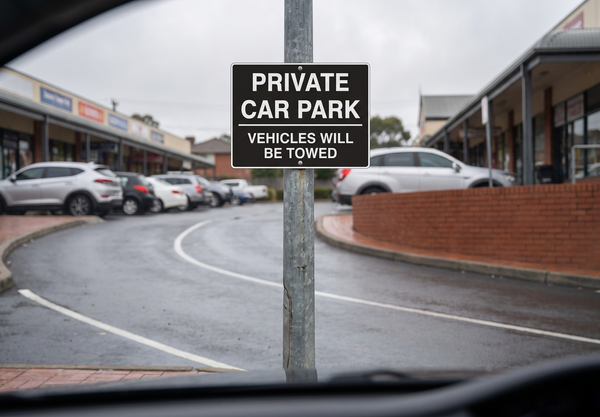
Related wording is worth keeping separate too. Keep Out signs and No Trespassers signs are boundary and property signs aimed at the public, not at workers; they pair naturally with CCTV and security signage at a perimeter. Site Access and induction wording belongs with construction site signage at a gate.

Where restricted access signs go
A restriction sign only works at the point where somebody is about to breach it.
- On the approach side of every entry point: each door, gate, hatch, ladder and stair that reaches the area, not just the main one.
- At eye height on the door leaf or the frame beside it, clear of handles, glazing and pin-boards, and visible with the door closed.
- At the boundary of an area, not deep inside it, where the restriction covers a zone rather than a room, such as a marked-off work area or a yard.
- Repeated along long frontages such as a mesh fence line, so the message is visible wherever somebody arrives at it.
- Outdoor-rated where it is exposed: metal or UV-stable poly rather than adhesive vinyl, which lifts and fades.
Some restricted areas carry their own signage duties on top of the general ones. Confined spaces are the clearest example: the WHS Regulations require a sign next to a confined space while entry work is being carried out, telling people that it is a confined space and that entry is by permit. Asbestos and hazardous chemical areas have their own requirements again. Check the duty that applies to the area before deciding a generic sign is enough.
Restricted access signage checklist
- Every entry point to the area is signed, including side doors, hatches and ladders
- The sign class matches the reason: prohibition for closed areas, danger for life-threatening hazards, notice for site rules
- Signs follow the AS 1319 format for their class, with no invented colour schemes
- Sign size suits the distance it must be read from
- Wording says who may enter, not just who may not
- Confined spaces, asbestos and chemical areas carry their specific required signage as well
- Signs sit at eye height, unobstructed, and are readable with the door shut
- Outdoor signs are on an outdoor-rated substrate
- Restrictions are actually enforced, because a sign nobody honours trains people to ignore the next one
- Signs are checked on a site walk-through for fade, damage and obstruction
* This checklist is provided as a general guide only. Signage duties vary by hazard, industry and jurisdiction. Always consult the current Australian Standards, your WHS regulator and a qualified safety professional for your specific circumstances.
Sign Your Restricted Areas Properly
No entry, authorised personnel only and keep out signs in AS 1319 formats, in metal, poly and self-adhesive.
Disclaimer: The information provided in this article is intended as general guidance only. Signage obligations for restricted areas differ by hazard, industry and jurisdiction across Australia, and the Australian Standards referenced here are revised from time to time. Always consult the current standard, your WHS regulator and a qualified safety professional to ensure signage is appropriate for your specific site and circumstances.