
Mandatory Signs in Australia: Blue Circle Signs Explained Under AS1319
The Blue Circle That Means "You Must"
Walk onto almost any Australian worksite, factory floor, or commercial kitchen and you will see them: blue circles with white pictograms telling you what you must do before entering or working in an area. These are mandatory signs, and they carry a simple, non-negotiable message — compliance is not optional. Unlike warning signs that alert you to a hazard or prohibition signs that tell you what not to do, mandatory signs direct specific actions that must be taken.
This guide explains how mandatory signs work under Australian Standards, the most common types you will encounter, and practical guidance on placement and compliance.
Mandatory Signs Under AS1319
Australian Standard AS1319 classifies safety signs into several categories, each with a distinct colour and shape. Mandatory signs are defined by their blue circular design with a white pictogram and, where needed, supplementary text on a white rectangle below the circle. The blue colour is reserved exclusively for mandatory instructions — it signals "you must do this" rather than "be careful" (yellow warning) or "do not do this" (red prohibition).
The standard requires that mandatory signs be placed at the point where the required action applies — typically at entrances to work zones or at the boundary of a hazard area. For most indoor workplaces, signs between 300mm and 600mm in diameter are standard. Larger signs are needed for outdoor areas or vehicle-accessible zones.
AS1319 also specifies that mandatory signs should use standardised pictograms wherever possible. A blue circle with a hard hat pictogram communicates its message regardless of the viewer's first language — important in Australian workplaces with diverse linguistic backgrounds. Where pictograms alone may be ambiguous, supplementary text should be added beneath the circle.
How Mandatory Signs Differ from Warning and Prohibition Signs
Understanding the distinction between these three sign categories is essential for selecting the correct signage.
Mandatory signs (blue circle): Instruct people to take a specific action — "Wear safety glasses," "Wash hands before returning to work," "Report to site office." The action must be carried out by anyone the sign applies to.
Warning signs (yellow triangle): Alert people to a potential hazard — "Caution: Wet Floor," "Warning: Forklift Operating Area." They inform the viewer of a risk but do not prescribe a specific action.
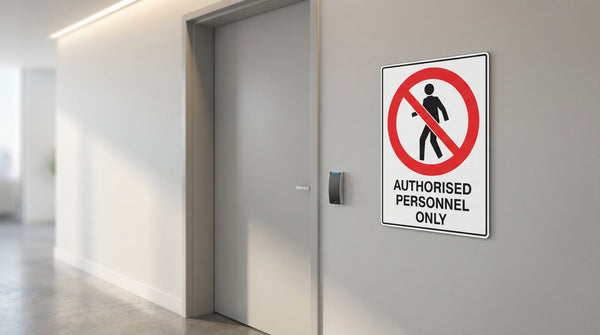
Prohibition signs (red circle with diagonal line): Tell people what they must not do — "No Smoking," "Do Not Enter." They forbid a specific behaviour.
In practice, these sign types often work together. A hazardous noise area might display all three: a warning sign identifying the hazard, a mandatory sign requiring hearing protection, and a prohibition sign restricting entry without PPE.
Most Common Mandatory Signs in Australian Workplaces
PPE Requirement Signs: Personal protective equipment signs are the most common type of mandatory signage — covering hard hats, safety glasses, hearing protection, high-visibility clothing, steel-capped boots, gloves, and respiratory protection. PPE signs should be displayed at every entry point to an area where specific equipment is required. Multi-condition signs displaying several PPE requirements on a single board are popular for construction sites and industrial facilities.
Hand Washing Signs: Essential in food preparation areas, healthcare facilities, and childcare centres. These signs typically show a blue circle with a hand-washing pictogram. Placing them at the entrance to food handling areas and beside wash basins supports compliance with food safety regulations.
Hearing Protection Signs: Any area where noise exceeds 85 decibels should be signed as a hearing protection zone. The mandatory sign — a blue circle with an ear muff pictogram — should be placed at every access point, often paired with warning signs identifying the high-noise area.
Hard Hat and Safety Boot Signs: Construction sites, warehouses, and areas with falling object risks require mandatory hard hat signs. Safety boot signs are similarly common in workshops and factories where heavy objects or sharp materials pose a foot injury risk.
Visitor and Contractor Registration Signs: "All Visitors Must Report to Reception" and "All Contractors Must Sign In" signs support site security and emergency management. Knowing who is on site is critical for evacuation procedures.
Common Mistakes in Mandatory Sign Placement
Placing signs too late: A mandatory sign should be positioned where a person can take the required action before entering the hazard zone. A "Hearing Protection Required" sign mounted inside a noisy workshop means workers are already exposed before they see the instruction. Always place signs at the boundary, not within the area.
Too many signs on one wall: Sign fatigue is real. When a wall is covered with dozens of signs, people stop reading any of them. Use multi-condition boards where several PPE items are required, and keep displays clean and organised.
Using text-only signs without pictograms: A text-only sign is not compliant with AS1319 and may not be understood by workers with limited English. Always use the standardised blue circle pictogram format.
Inconsistent placement: If signs are at eye level in one area and above head height in another, workers lose confidence in the system. Establish a consistent mounting height — between 1.8 and 2.4 metres is practical for most environments.
Not updating signs when hazards change: If a machine is decommissioned and noise levels drop, the hearing protection sign should be removed. Outdated mandatory signs undermine the credibility of all your signage.
Forgetting internal zones: Many workplaces sign the main entrance but forget transitions between internal areas. If the warehouse requires PPE but the adjacent office does not, a mandatory sign should mark that boundary.
Maintaining Mandatory Sign Compliance
Installing mandatory signs is not a one-off task. Include signage in your routine safety inspections — checking that signs are present, legible, correctly positioned, and still relevant. Keep a register of mandatory sign locations so inspections can be conducted against a known baseline.
Training matters too. Induction programmes for new staff and contractors should include a walkthrough of the site's mandatory signage, reinforcing that the blue circle is not a suggestion — it is an instruction.
When signs need replacing, source signs that meet AS1319 from a reputable supplier. Non-compliant signs from overseas or printed on consumer-grade materials may fail prematurely and could be flagged during a regulatory inspection.
Key Takeaways
- Mandatory signs in Australia are blue circles with white pictograms under AS1319 — they instruct specific actions that must be taken.
- They differ from warning signs (yellow triangles — alerting to hazards) and prohibition signs (red circles — forbidding actions).
- PPE requirement signs, hand washing signs, and hearing protection signs are among the most common mandatory signs in Australian workplaces.
- Place mandatory signs at the boundary of the hazard zone — before entry, not after.
- Use standardised pictograms for multilingual comprehension and add supplementary text where the pictogram alone may be unclear.
- Conduct regular audits to keep mandatory signage current, visible, and credible across the entire workplace.
Get the Right Mandatory Signs for Your Workplace
From PPE requirement boards to hand washing signs and hearing protection — browse our full range of AS1319-compliant mandatory signage.
Disclaimer: The information provided in this article is intended as general guidance only. Workplace health and safety regulations, including signage requirements, may vary between states and territories across Australia. Always consult your local regulatory authority and seek professional advice to ensure compliance with the specific requirements applicable to your workplace and jurisdiction.