
Warehouse & Forklift Safety Signs
Warehouses are among the most hazardous workplaces in Australia. Forklifts weighing several tonnes operate alongside pedestrians, heavy loads are stored at height, and the pressure to move goods quickly can lead to shortcuts that put people at risk. Safe Work Australia data consistently shows that transport, postal, and warehousing industries account for a disproportionate share of serious workplace injuries and fatalities.
Safety signage is one of the most effective and economical controls for managing warehouse risks. When properly selected and positioned, signs communicate hazards, direct traffic, and reinforce the safe systems of work that keep people alive. This guide covers the essential signage categories every Australian warehouse and distribution centre should have in place.
Essential warehouse safety signs (before we get to forklifts)
Forklifts are the highest-risk activity in most warehouses, but they're not the only thing that needs signage. A compliant warehouse safety sign programme starts with the broader hazards — manual handling, racking integrity, fire egress, hazardous chemicals — and uses forklift-specific signage as one layer on top.
The core warehouse safety signs every Australian facility needs are:
- PPE entry signs at every entry point — typically hi-vis vest, safety boots, hard hat where overhead work occurs
- Speed limit signs for both pedestrians and material handling equipment
- Emergency exit signs at every fire-rated egress door (AS2293 compliant)
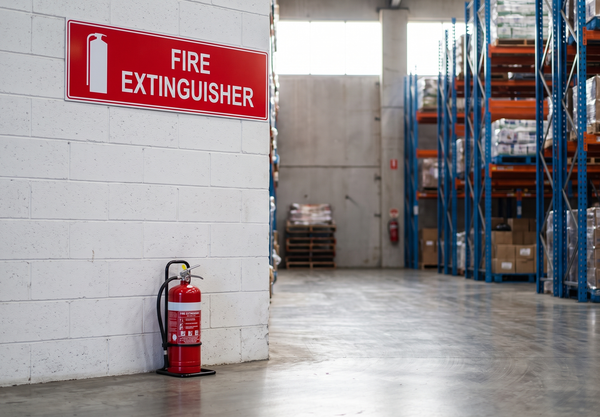
- Fire equipment signage marking extinguisher and hose-reel locations
- Racking load-limit plates on every bay (Safe Working Load notices)
- Hazardous chemical storage placards where dangerous goods are kept
Once those baseline warehouse safety signs are in place, forklift-specific signage — pedestrian zones, traffic management, loading bay markings — adds the next layer of risk control. The rest of this article focuses on that forklift layer in detail.
Forklift Operating Area Signs
Forklifts are involved in a significant proportion of serious warehouse injuries. Collisions between forklifts and pedestrians, tip-overs, and crushing incidents account for the majority of these events. Clear signage identifying forklift operating areas is a fundamental control measure.
Warning signs indicating "Forklift Operating Area" or "Warning: Forklifts in Use" should be displayed at every entry point to areas where forklifts operate. The yellow triangle format makes them immediately recognisable as hazard alerts under AS1319.
Supplementary signage can specify the types of forklifts in use, operating hours, and speed restrictions within the zone. In facilities with multiple types of powered equipment, such as reach trucks, order pickers, and counterbalance forklifts, signage identifying the specific equipment helps workers understand the risks.
Prohibition signs stating "No Pedestrians" in dedicated forklift aisles reinforce the physical separation between pedestrian walkways and vehicle routes. These are particularly important at intersections where pedestrian paths cross forklift zones.
Pedestrian Safety and Traffic Management
The separation of pedestrians and forklifts is the single most important safety measure in any warehouse. Physical barriers such as bollards and guardrails form the primary controls, but signage is the communication layer that makes these controls understood and respected.
Pedestrian walkway signs direct foot traffic along designated safe routes. These routes should be marked with floor paint or tape and reinforced with wall-mounted signs at regular intervals. At points where pedestrian paths intersect with forklift routes, warning signs and stop signs help both parties manage the crossing safely.
Speed limit signs apply to both forklifts and other vehicles. A common limit is 10 km/h in general warehouse areas, with lower limits near pedestrian crossings, dock doors, and blind corners. Displaying the limit prominently and repeatedly reinforces expectations.
Mandatory signs requiring high-visibility vests for all personnel in warehouse areas are standard practice across Australian facilities. High-visibility clothing makes pedestrians easier for forklift operators to see, particularly in facilities with limited lighting. Our PPE signs guide covers mandatory personal protective equipment signage in detail.
Loading Dock Safety Signs
Loading docks are transition zones where the controlled warehouse environment meets the outside world. Trucks reverse into position, dock levellers bridge the gap between vehicle and building, and goods are transferred under time pressure. This combination of heavy vehicles, moving equipment, and height differences makes loading docks one of the highest-risk areas in any warehouse.
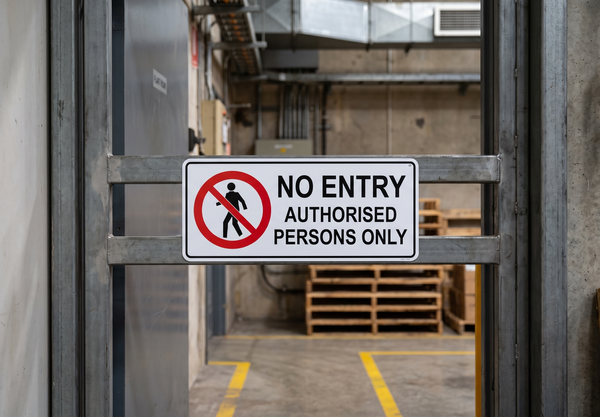
Warning signs at loading dock approaches should alert both truck drivers and warehouse staff to hazards present. Signs indicating "Loading Dock: Authorised Personnel Only" restrict access to trained workers. Edge protection warning signs along dock edges help prevent falls, a common cause of serious injury.
Chock wheel signs remind drivers and dock staff to secure vehicles before loading or unloading begins. If a truck moves unexpectedly while a forklift is operating between the vehicle and the dock, the consequences can be catastrophic.
Traffic management signage around the external dock area directs truck movements, identifies reversing zones, and separates vehicle movements from pedestrian activity.
Racking Load Limit Signs
Pallet racking collapse is a low-frequency but high-consequence event. When racking fails, the cascading weight of stored goods can cause fatalities and significant property damage. One of the most common causes is overloading.
Australian Standard AS4084 (Steel Storage Racking) requires that racking load limits be displayed on or near the racking system. These signs specify the maximum load per bay, per beam level, and sometimes per individual pallet position. The information must match the design capacity calculated by the racking engineer.
Load limit signs should be positioned at the end of each racking aisle where forklift operators and staff can read them easily. The signs must include specific weight limits in kilograms and any restrictions such as maximum pallet dimensions or stacking configurations.
Regular racking inspections should verify that load limit signs are present, legible, and accurate. Any changes to the racking configuration may require recalculation of load limits and updated signage. Displaying outdated load limits is potentially as dangerous as displaying none at all.
Hazardous Materials and Chemical Storage Signs
Many warehouses store hazardous materials, from cleaning chemicals to flammable liquids and corrosive substances. The storage and handling of dangerous goods is governed by workplace health and safety regulations and the Australian Dangerous Goods Code.
Hazardous material storage areas require specific signage identifying the class of dangerous goods, the associated hazards, and any special requirements. Prohibition signs forbidding smoking, naked flames, and unauthorised entry are standard around dangerous goods storage.
Emergency signs identifying safety showers, eyewash stations, and spill kits should be clearly visible from any point within the hazardous storage area. First aid signs directing workers to the nearest first aid kit are equally important. For more on hazard identification, see our pipe marker signs guide.
Common Warehouse Accidents Prevented by Proper Signage
While signs alone cannot prevent accidents, they are a critical layer in the hierarchy of controls. Understanding the incidents that signage helps prevent reinforces the value of getting your strategy right.
Forklift-pedestrian collisions are among the most serious warehouse incidents. Warning signs at forklift zone entries, no pedestrian signs in vehicle aisles, and mandatory high-visibility clothing signs all contribute to reducing this risk.
Falls from height occur at loading docks, mezzanine levels, and around racking. Edge warning signs and fall hazard warnings at elevated areas support awareness and safe behaviour.
Racking collapse can result from overloading, forklift impact, or structural failure. Load limit signs address overloading, while speed limit signs in aisles help reduce impact incidents.
Struck-by incidents from falling objects are common where goods are stored at height. Hard hat mandatory signs in racking aisles and warning signs below elevated storage help protect workers.
Key Takeaways
- Forklift operating area signs and no pedestrian signs are essential for separating people from powered equipment
- Speed limit signs throughout the warehouse apply to both forklifts and other vehicles, typically 10 km/h or lower
- Loading dock signage should cover wheel chocking, authorised access, edge protection, and reversing vehicle warnings
- Racking load limit signs are required under AS4084 and must be accurate, legible, and updated after any changes
- Hazardous materials storage requires class-specific dangerous goods signage plus emergency equipment location signs
- Regular signage audits should verify that all signs remain compliant, visible, and relevant to current operations
Equip Your Warehouse with the Right Safety Signs
From forklift warnings to racking load limits, browse our full range of warehouse safety signage in durable materials built for demanding environments.
Disclaimer: The information provided in this article is intended as general guidance only. Workplace health and safety regulations, including signage requirements, may vary between states and territories across Australia. Always consult your local regulatory authority and seek professional advice to ensure compliance with the specific requirements applicable to your workplace and jurisdiction.